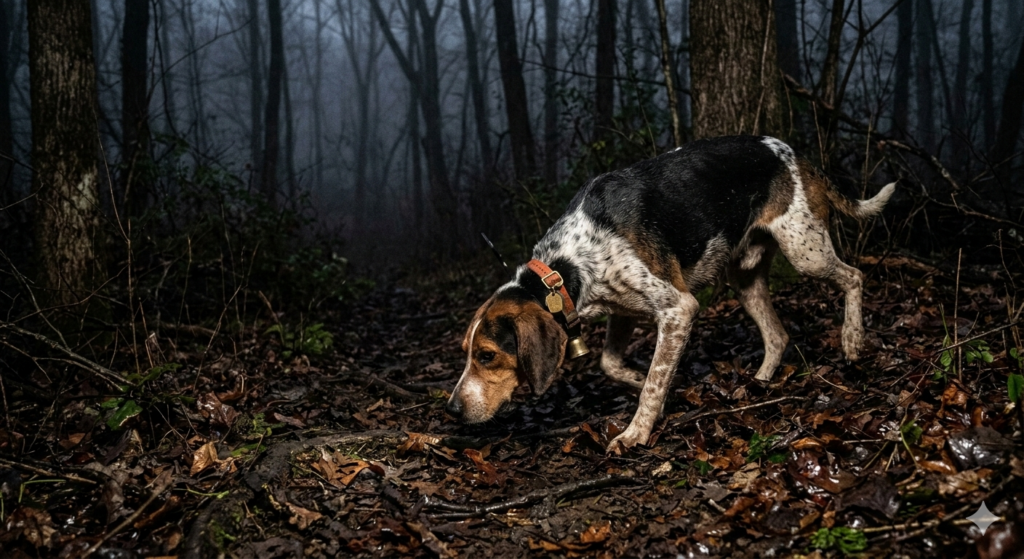
The dog strikes a track and the woods come alive. You can hear it pushing hard, moving fast, covering ground. Sounds good. Sounds like a dog doing its job.
Then the track turns. And the dog keeps going straight.
You hear it casting out ahead, searching, circling wide. It checks left. Checks right. Eventually it either relocates or the track dies cold out in front of it. That dog did not blow the track because it lacked nose. It blew the track because it outran its nose.
This is one of the most common things you will see in young coonhounds. And it is one of the most misread.
Speed Is Not Accuracy
A fast young dog looks impressive in the dark. It moves with urgency. It is loud, it is committed, it covers ground. Handlers see that and think they have something special.
Sometimes they do. But speed and accuracy are two different things, and in trailing work, accuracy is the one that matters.
Scent is not a straight line. A raccoon moves in arcs, stops, doubles back, cuts across its own path. A track through heavy timber in September smells nothing like the same track across a gravel bar where temperature dropped twenty degrees since midnight. Scent pools in low spots. It thins on ridges. It shifts with wind.
A dog running at full speed through all of that is working on momentum, not scent. It is outpacing the information it actually needs to follow the line.
You can find more on why track conditions demand a slower, more deliberate approach in this piece on how to teach a young coonhound to slow down on cold tracks. That same concept applies here. Hot track or cold, the nose has to stay connected to the ground.
What Overrunning a Turn Actually Looks Like
Picture a hollow bottom, wet leaves, low fog sitting about knee high. A coon moved through here two hours before the dog hit the track. The dog is driving hard down the bottom, nose skimming, pushing scent from one step to the next.
Then the coon turned uphill at a downed log and crossed the ridge. The scent column the dog was following ends at that log. But the dog is already twenty yards past it when the scent disappears.
A young dog does not stop. It does not circle back to the log. It casts forward, looking for more scent out ahead. It drifts. It checks the ridge, checks the far side, widens its search in the direction it was already moving. In that moment the dog is guessing. It is not trailing.
Sometimes it gets lucky and picks up scent on the far side of the ridge where the coon traveled. The handler thinks the dog recovered. What actually happened is the dog got away with overrunning the turn. That is not the same thing.
Drifting vs Trailing: Know the Difference
Drifting is when a dog moves through an area searching for scent without staying connected to a confirmed line. The dog is in motion. It may be working. But it is not on a verified track.
Trailing is different. Every step a trailing dog takes is supported by scent under its nose. It slows when the scent thins. It stops when the line ends. It works back to the last confirmed point before it moves forward again.
A drifting dog may get lucky and find the track again. A dog that trails will find it almost every time.
Young dogs drift because they are operating on excitement. They have not yet learned that when scent disappears, moving forward is the wrong answer. The instinct is to keep going. The skill is knowing to stop.
How a Finished Hound Handles a Track Loss
Watch a finished hound work a track to a loss and you will see something that looks almost slow by comparison. The dog hits the end of the confirmed scent and it does not lunge forward. It slows. It begins to circle the loss, keeping the last confirmed point near the center of its search.
It is methodical. It checks the wind. It works tight arcs, then wider ones if needed. It is not guessing. It is eliminating. Every arc that comes back empty tells it something about where the coon did not go. Eventually it cuts fresh scent and the line fires back up.
That behavior was not installed. It was learned. The dog ran into enough losses and had enough experience working them out that it developed a reliable process. The young dog blowing through turns has not had enough of those moments yet.
When to Let the Dog Work and When to Step In
This is where handlers get it wrong in both directions.
Some handlers jump in the moment a young dog overruns a turn. They hustle out, put the dog back on the track, point at the ground, try to show it the line. That robs the dog of the problem-solving experience it needs. A dog that gets rescued every time it makes a mistake never develops the self-correction instinct that finished hounds have.
Other handlers are so hands-off they let a young dog spend forty-five minutes drifting through the wrong county. That is not learning. That is a dog practicing bad habits.
The middle path is patience with a boundary. Let the young dog work the loss. Give it time to cast, circle, figure it out. But if it has drifted beyond reasonable range of the track and shows no sign of relocating, stepping in is appropriate. Get it back to the last confirmed point and give it another chance from there. Do not do the work for the dog. Just reset the problem.
Handlers who push a young dog too fast through this development phase often create dogs that look fast but trail poorly. It is worth reading through the broader context of stop comparing your coonhound to other dogs in development. Every dog builds this skill at its own pace.
Why Some Dogs Look Impressive but Struggle with Accuracy
Speed is visible. Accuracy is not, at least not right away.
A dog that drives hard and opens loud gets attention at the truck. It gets talked about. But many of these dogs are simply blowing through tracks, and handlers who do not know better think they are watching something great.
But if that dog consistently overruns turns, drifts at losses, and relies on luck to relocate the line, it is not a great trailing dog. It is a fast, enthusiastic dog that happens to find coons when conditions are easy. Put it on a two-hour-old track in dry weather with a wind shift and it will fall apart.
The dogs that hold up in real conditions are the ones that stay honest with their nose. They may not look as flashy at the start. But they tree the coon at the end of the night.
Devil’s Advocate
Some handlers will say that a fast dog with good drive will sort itself out over time, that the nose will catch up to the legs. There is some truth in that. Drive matters. A dog with no forward push is its own problem.
But drive without accuracy is just noise in the woods. The dogs that develop into reliable trailers are the ones that learn to check themselves. That happens through exposure to track losses, not despite them. A handler who keeps conditions too easy for a young dog, always running it on fresh tracks in good weather, is delaying the education the dog actually needs.
Letting young dogs struggle with difficult tracks on purpose is not cruelty. It is the whole point. The frustration of a lost track is what teaches a dog to slow down before it loses the next one.
Quick Fix Checklist
- Watch where the dog was when scent ended. Mark that spot in your head.
- Let the dog cast on its own before stepping in.
- If the dog drifts past reasonable range, bring it back to the last confirmed point only.
- Do not point at the track or help the dog nose it out. Reset the problem, let the dog solve it.
- Run young dogs on tracks that challenge them, not just tracks they can handle easily.
- Pay attention to the difference between a dog working a loss and a dog drifting blind.
- Track your dog’s accuracy over multiple nights, not just whether it treeed.
- A dog that trees every night but regularly overruns turns is a dog with a developing problem, not a finished dog.
The Dog That Gets There
A dog that learns to work a loss honestly is worth more than a dog that runs fast and gets lucky.
Speed fades as conditions get harder. A solid nose paired with the discipline to use it correctly keeps working. That is the kind of dog that makes it through a long season without falling apart when the tracks go cold or the weather turns wrong.
Build it right. The dog that gets there slow is the one that keeps getting there.
For a full breakdown of building a reliable trailing hound from the ground up, visit our coonhound training pillar for everything we have covered in this series.